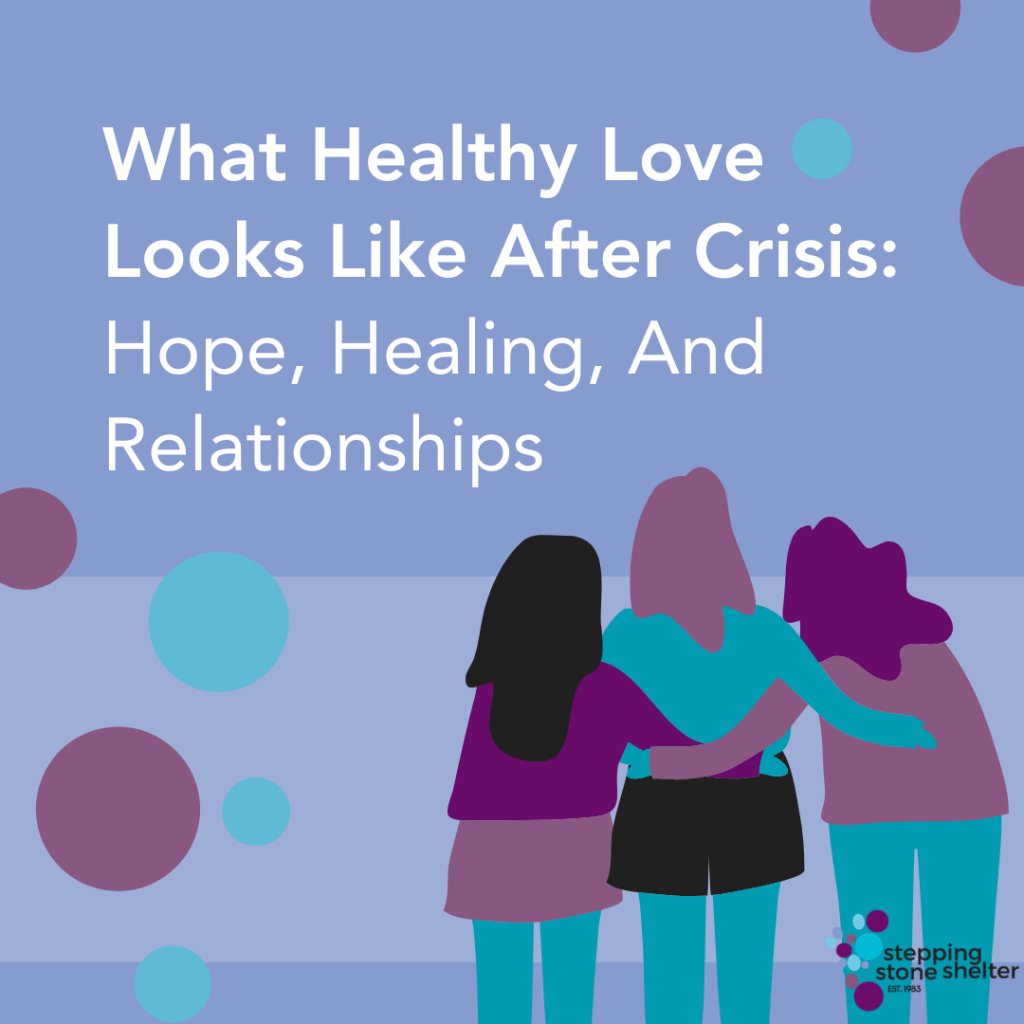
For survivors of domestic violence, the idea of ‘healthy love’ can feel complicated or intimidating. Even the word ‘love’ can carry mixed emotions: longing, fear, grief, and hope all at once. After escaping an abusive relationship, survivors may face challenges when trying to form a new, healthy relationship later on. Trust is fragile, and it may be traumatic or scary for survivors to enter a new relationship. Healing after a crisis is a complex journey that is not always linear, and many survivors of domestic violence face challenges while in pursuit of a new relationship.
At Stepping Stone Shelter, we have spent 43 years walking alongside survivors as they move from crisis to stability, fear to safety, and surviving to living. In all these years, we can attest that healing and healthy love are possible. There are a few steps you can take after a crisis to help with hope, healing, and finding healthy love.
Re-Building The Relationship With Yourself
After experiencing abuse, it’s common for survivors to feel as if they’ve lost connection with themselves. Domestic violence erodes confidence, distorts self-worth, and lowers self-esteem. The first relationship after experiencing a crisis is not romantic; it’s the relationship you rebuild with yourself.
Self-love in the context of healing from a crisis can look like honoring your boundaries, allowing yourself to rest, seeking support when you need it, and learning to trust your own judgment again. We have watched countless survivors rediscover themselves. Whether that means going back to school, rediscovering old hobbies, or attending support groups, it looks like finding peace, even when chaos feels familiar.
Understanding Red Flags
By no means is it ever possible to predict that a relationship can turn into a crisis; however, there are certain red flags to look out for in a potential partner. Part of healing is learning to recognize these red flags and use them as tools of protection.
Red flags can look like: isolating you from friends and family, rushing intimacy or commitment, jealousy disguised as affection or “protection”, overstepping your boundaries, blaming you for their emotions or actions, and controlling day-to-day life, like finances, social media, or communication with other people.
Recognizing these hallmarks can be difficult because abuse often starts subtly. These actions can be wrapped in charm, affection, or intensity. Survivors may struggle with realizing that these actions are red flags because certain behaviors feel familiar even if they’re harmful.
Recognizing Green Flags
Part of identifying what healthy love looks like is also being able to recognize the green flags in a potential partner. Some survivors share that healthy relationships may feel “boring” in comparison to the highs and lows of abuse in the initial stages of healing. This is not because the partner is actually dull, but rather a psychological response to transitioning from a chaotic, high-stakes relationship to a safe, steady one.
Green flags in a relationship can look like: respect for boundaries, consistent communication, accountability for their mistakes, encouragement for your independence, support for your friendships and interests, and emotional safety, such as being able to disagree without fear.
Healthy love means you don’t have to shrink, prove your worth, or feel bad for having needs. In a healthy relationship, conflict can be addressed without threats, and apologies are sincere and followed by changed behavior.
Moving At Your Own Pace
After 43 years of working with and advocating for survivors, we know that there is no timeline for healing and that no path looks the same. Some survivors choose to focus on personal growth, and others enter new, healthy relationships once they feel ready. Both paths are completely valid.
Healing looks different for everyone, and it’s not always linear. Triggers may arise unexpectedly, so be patient with yourself. Healing after a crisis includes open, honest conversations about past experiences, a support system that listens without judgment, and patience.
Hope For The Future
For 43 years, Stepping Stone Shelter has been a place where survivors find more than just emergency housing. Here, they find advocates, a support system, volunteers, and fellow survivors who are here for them. If you are a survivor of domestic violence and are wondering whether healthy love is possible for you, we want you to know that it is. Your past does not define you, and it does not mean you can’t have a safe, joyful future.
Healthy love after a crisis looks like freedom, safety, choice, mutual respect, and believing that you really deserve it. Everyone deserves a life safe from violence. If you or someone you know is navigating life after abuse, you are not alone. Healing, growth, and safe, steady love are possible.